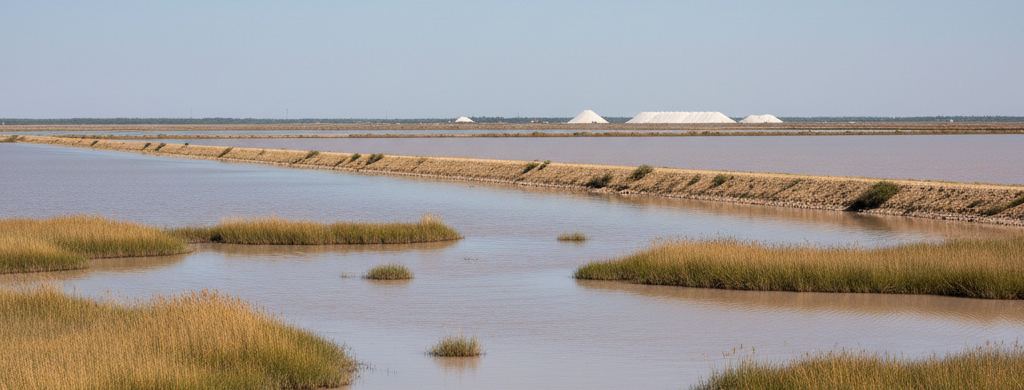
Salt pans, reed beds and grazing pasture between two river arms
Salt lagoons and grazing marsh: a six night Camargue week reserved between the Rhone arms
From $1,340 per person, two sharing a double room, for six nights. The office books this week in April, May, September and October, and prints it twice on this page: the same dates at their best and at their worst. The spread mark is narrow, which means the poor version of this week is a disappointment rather than a different holiday.
Reserve one of these weeksSend the form whenever it suits: it never shuts. Someone here replies inside one working day, and no charge arises at this end.
One week, written out twice
One set of dates, one set of rooms, the same guides and the same $1,340. The variable is the place itself, which answers to nobody here. Both readings appear below because both are real.
At its best
The wind has come through and gone, and the air behind it is clear enough to see the Alpilles from the dyke road. Water sits high in the lagoons. You walk the sea dyke in the morning with the salt flats on one side and grazing marsh on the other, and the shallow edges are crowded with feeding birds: flamingos standing in the pink water, avocets, terns working the channels. Horses graze loose in the enclosures behind the reed. In the afternoon you ride bicycles on the flat lanes between rice fields and stop where the salt works pile their harvest into white hills. Evening light on the salt lasts an hour. Dinner is bull meat and rice from ten miles away, eaten outside, in a village where the church roof is the highest thing for twenty miles.
At its worst
Same beds, same guide, same figure. The wind does not stop. It blows for most of the six days, hard enough down the delta to put the lagoons into grey chop with nothing standing in them. Birds move inland to sheltered pans you cannot reach on foot, so the walking days give you reed noise, a horizon and very little else. Cycling into that wind is work rather than pleasure, and one afternoon gets given up to it. If the wind drops instead, what replaces it is still air, cloud at one flat grey level, and mosquitoes off the marsh from six in the evening onward. What still stands: the dykes are walkable in any weather, the salt hills do not go anywhere, the villages and the food are unchanged, and the guide knows which side of which lagoon is worth the drive. This is the narrow mark. You lose the light and the numbers, not the week.
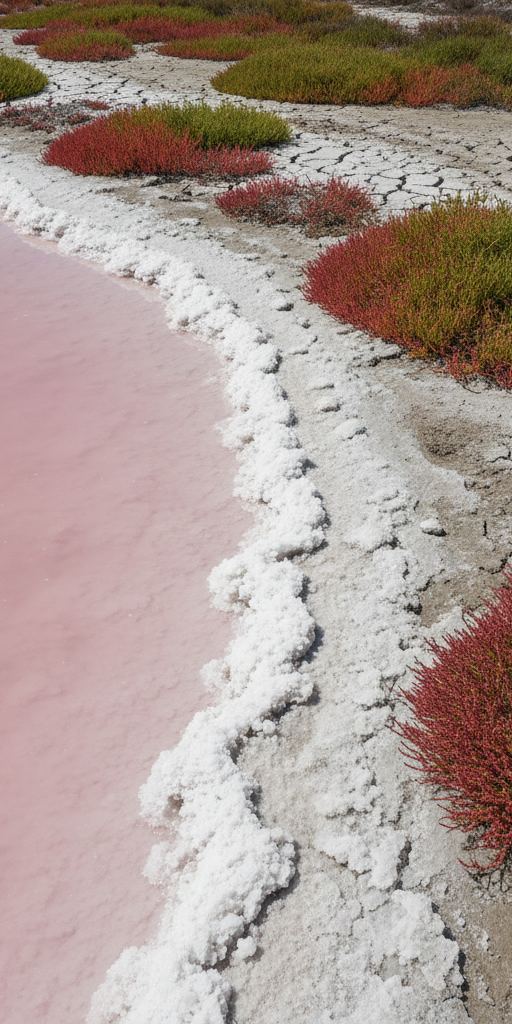
Close upright view of a salt pan edge, crusted white rim and red glasswort
Two arms of the Rhone split above Arles and rejoin the sea about thirty miles apart. Between them lies flat ground that is half water: brackish lagoons, salt pans still worked commercially, rice paddies on the fresher northern edge, and a grey green scrub of glasswort that turns red in autumn. Nothing on it is high. A raised dyke of two metres counts as a viewpoint, and from one you can see for fifteen miles in every direction. Black cattle and pale horses graze the enclosures under the management of the estates that own them. The sea edge is a sand bar with a long track along it. Roads are few, straight and slow, and much of the interior is reached only on foot, by bicycle or in a flat boat.
A day between water and pasture
Three of the six days are guided by a naturalist who lives in the delta and works the same ground all year. Those days start early, because the light is best before nine and the birds are on the near lagoons before the boats move. You walk between four and eight miles on flat dyke tracks, with a telescope set up wherever there is something to look at. One day is spent in a shallow draught boat on the channels. One is given to the salt works and the villages at the western end. The other two days are yours, with bicycles included and a printed set of routes at the guesthouse. Nothing is strenuous. The hardest thing about the Camargue on foot is the wind and the absence of shade.
Inside the figure, and outside it, in practice
From $1,340 per person, two sharing a double room. Inside it: six nights in a small family run guesthouse near the eastern lagoon, breakfast every morning, three guided days including boat time and the use of a telescope, bicycles for the week, and transfers between the arrival station and the guesthouse. Outside it: getting to France, which is your own booking and not something this office arranges; four dinners; drinks; insurance of any kind, which this office does not sell; and anything you spend on your own days. The company that runs the week bills you directly in its own name and takes your card details itself. This office holds no card, takes no payment, and settles with this end once you are home. Confirmation of the figure comes before any dates are held. The figure is confirmed in writing before anything is committed.
Nights
6
From
$1,340 per person, two sharing
When it runs
April, May, September, October
Spread between the two versions
Narrow
What the figure holds
Rooms for the nights stated, the guided days set out on this page, admissions belonging to those days, and whatever the running company charges for its own part.
What it leaves out
Reaching the country and leaving it again, any meal not listed above, anything personal, and anything agreed later.
Who invoices you
The company that runs the week, in its own name.
Asked before anybody commits
Will we see flamingos?
The office does not know and will not say. Birds move between lagoons with wind and water level, and some weeks the shallow edges near the guesthouse are empty. What is fixed is the ground, the guide and the boat day. If seeing a particular species is the reason you are going, this is the wrong week to buy, and the office will say so on the phone.
Can you book your own flights to France?
No. Air seats and sea berths fall outside this business, and not one carrier holds a contract here, so your travel to and from France is your own booking. What the office will do is tell you which arrival day the week starts on, what time the transfer runs, and how long the road takes from the two nearest airports, so you can book around it.
Why is the same week printed twice at one price?
Because both versions cost the same to run and the office cannot control which one you get. The rooms, the guide, the boat and the six nights are identical. Only the weather, the water level and the birds differ, and nobody sells those. Printing the poor version next to the good one is the only honest way to quote a place like this.
Finish the sentence and a week gets reserved
Whatever the hour, what you send lands here and is read by a person, who replies inside one working day. Sending it binds you to nothing, and no sum is ever taken at this end.